
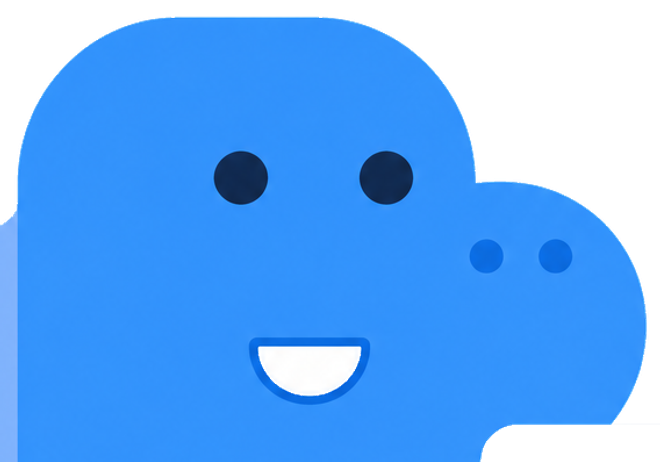
Nobody reads a privacy policy. Everybody looks at a dinosaur.
By 2014 Facebook had a reputation problem it could not fix with legal text: people kept posting to Public without realising it. Vacation photos, family arguments, job complaints — all of it addressed, by default, to the entire internet.
The settings existed. They were buried in menus almost nobody opened. So instead of rewriting the policy again, Facebook rewrote the messenger, and made it impossible to ignore: a chubby, friendly, unmistakably blue cartoon dinosaur.
A mascot whose entire job is to interrupt you
The dinosaur shows up holding a small blue sign, right at the moment you are about to publish something publicly, and asks a single question: are you sure this is the audience you meant?
It was deliberately non-threatening. A padlock icon warns you. A dinosaur just tilts its head. The tone did the work that a warning banner could not — press at the time compared it, not always kindly, to Microsoft's Clippy: the assistant that pops up whether or not you asked for it.
“A blue dinosaur becomes a Facebook ambassador for 1.28 billion people.”
— The New York Times, Bits blog, May 22, 2014
The Privacy Checkup
Behind the mascot sat a real tool. The Privacy Checkup was a one-time pop-up that walked you through who could see your posts, which apps you had connected, and what your profile revealed — a quick sweep of your own account, in plain language rather than settings jargon.
Alongside it came the change that mattered most: for new users, the default audience for a first post switched from Public to Friends. The dinosaur got the attention; the default got the results.
How it played out
First sightings
Screenshots of a blue cartoon dinosaur asking about sharing settings start circulating in the tech press, ahead of any broad rollout.
The Zuckasaurus gets its name
The New York Times covers the mascot on its Bits blog and nicknames the creature after Mark Zuckerberg. The name sticks better than the feature does.
A new default
Facebook announces that new accounts will post to Friends rather than Public by default, and starts prompting existing users to review their audience.
Checkup goes wide
The Privacy Checkup rolls out more broadly. Commentators start arguing that other platforms need a dinosaur of their own.
The most effective privacy UI ever shipped was a cartoon
The Zuckasaurus is remembered because it solved a design problem, not a legal one. It moved the question from a settings page nobody visits to the exact second where the decision is actually made, and it asked in a voice that nobody felt lectured by.
That is the whole lore: a company with 1.28 billion users decided the best way to talk about privacy was to stop talking like a company.
Read the original
- A Blue Dinosaur Becomes a Facebook Ambassador for 1.28 Billion People The New York Times, Bits blog — May 22, 2014
- Forget Godzilla: Facebook rolls out its own dinosaur CNN Business — May 23, 2014
- Facebook launches its own Clippy: the “Zuckasaurus” privacy assistant Neowin — 2014
- Facebook's privacy dinosaur: privacy checkups take aim at oversharing Slate — March 2014